
DAY 14 - BORAMARAÚ
Updated: May 7
Public image and coexistence in the territory
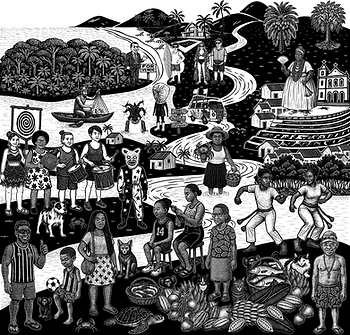
BoraMaraú wheatpaste panel was created in December 2025, following an invitation from Eduardo, a seasonal resident of Algodões and political activist. Like us, he came from Brazil’s Southeast and maintains an ongoing attention to local community issues, especially regarding forms of coexistence, permanence, and participation in the territory. The work was installed at Casa Taba Maraú and emerged during the same period as other actions developed in the village of Algodões, as part of a broader process of engagement and coexistence within the territory.
Casa Taba Maraú, beyond its role as accommodation, functions as a meeting point. It is a space where residents, visitors, and local initiatives come together through gatherings, conversations, political articulation, and collective practices. It was in this context that the invitation arose, as an extension of relationships already in place. Installing the panel in this space allows it to integrate directly into the everyday use of the site, being gradually seen by those who frequent it, pass by, or recognize something in it, without a single, defined moment of presentation.

The panel emerges from a selection of shared experiences over nearly two years of living in the village. It does not aim to represent the place in its entirety, but rather to bring together elements of daily life: gestures, situations, relationships with the environment, and ways of working and remaining.
The image is built from references to Northeastern Brazilian woodcut printmaking, not only in formal terms but also in its modes of circulation and public character, although it was produced with the support of artificial intelligence and structured using digital illustration tools. The use of wheatpaste as a medium reinforces this dimension, placing the image in direct contact with the street, exposed to time, wear, layering, and the presence of passersby.
By bringing together scenes related to the territory of the Maraú Peninsula, the panel forms a non-linear composition. The images coexist side by side, without hierarchy, as in everyday life: fishing, movement, work, rest, local culture, relationships between people and with the landscape. There is no single narrative, but a set of situations that can be recognized.

The work is also situated within a broader context marked by recent transformations in the region. The growing presence of investors, the rise of tourism, and changes in land use have generated tensions around the permanence of local populations. In this context, the panel does not aim to illustrate a specific conflict, but to affirm the ongoing presence of those who sustain the territory in everyday life.
More than a tribute, BoraMaraú positions itself as a gesture of recognition. The people represented — even if not individually identified — refer to a body of knowledge and practices that structure local life: knowledge of tides, fishing, cultivation, and ways of relating to the environment.
BoraMaraú is thus connected to a broader set of practices being developed in the region, including the Teteia project — which seeks to establish long-term relationships with the territory, including the creation of a memory center focused on listening, documentation, and the sharing of local experiences.
In this sense, the panel does not stand as an isolated work. It functions as part of a larger process, in which image-making is tied to coexistence, presence, and the continuity of relationships.
#BoraMaraú
Comments